Authors are often asked where we get our ideas. I get mine from fortune cookies.
Just kidding.
I got the idea for CANALS after driving over, or next to, yet another irrigation canal in Modesto, California. One day I thought, what if there was a monster in the canals? Man, no one would be safe because those canals are everywhere. Just about everyone who lives in Modesto and has a decent arm could throw a rock into an irrigation canal from somewhere on their property.
I got the idea for THE MIGHTY T from a newspaper article about the O’Shaughnessy Dam and the Tuolumne River. That dam is still a hot topic today. Environmentalists want it torn down so the Hetch Hetchy Valley can be restored... Well, not all environmentalists. The ones in San Francisco don’t because they get their clean, pure drinking water form the Hetch Hetchy Reservoir.
I wrote DEATH OF A MATADOR after attending a Portuguese bloodless bullfight in Stevensen, California. It was one of the craziest things I’d ever seen and I thought it would made a good story.
SUNSET HILL followed MATADOR, but wasn’t inspired by anything other than the fact that Mindy got away at the end of THE MIGHTY T. She was too good a character to just let go like that.
The idea for THE KING OF ROUND VALLEY sprung from a location: the place Grant ended up at at the end of SUNSET HILL. That’s where he was so I began looking into what might be going on in Mendocino County...
Image by Vjeran Lisjak
Then, yesterday morning, I was on the treadmill at the gym listening to a podcast titled Predicting The Future, an episode from the NPR: TED Radio Hour Podcast. (You can subscribe to the podcast on iTunes, like I do, or download it directly from the site.)
Because I only walked for 30 minutes, I only made it up to Marc Goodman’s section, What Does The Future Of Crime Look Like? I was particularly struck by Nina Tandon’s and Richard Resnick’s segments. Tandon’s company is growing bones from stem cells and Resnick says sequencing genes will likely change the way we live.
Now, couple this with my recent experiences in ordering a new iPhone and iPad and ... BAM! An idea for a story sprouted. At first it was a short story, but after I’ve a couple of days to play with it, it’s gonna be a novel. And I think it’s gonna be really good.
It’ll be about the way we pick our children in, oh, about a hundred years from now.
I wrote a couple of posts in September and October, 2011, on formatting for eBooks and print. The first post covered the ellipsis, the second em and en dashes. In summary, for the click-shy, I recommended:
Ellipsis
Print Formatting
I recommend the use of space-period-space-period-space-period-space (three periods, each surrounded by a space) when the ellipsis is in the middle of a sentence.
If ellipsis is at the end of a sentence, instead of the last space, insert whatever punctuation mark is appropriate. I don't use a fourth period at the end of a sentence in fiction like I would if I were publishing non-fiction. A close quote mark, question mark, or exclamation mark would immediately follow the last period with no additional space.
You or may not need to use a nonbreaking space between the preceding word and the first period, to keep them on the same line. That's handled in the copy-fitting stage, when you're examining each page of your manuscript in your page layout program.
eBook Formatting
I recommend the use a true ellipsis in eBook formatting. The only downside to this is, the eReader could choose to split a line at the end of the word, making an orphan of the ellipsis. The only way I know to prevent this would be to use an HTML editor and insert a zero width non-breaking space. Editing HTML is outside my skill set. I write my novels in Scrivener and use it to generate my eBook files.
In a comment I made at the end of the ellipsis post, I wrote you could also use the three periods surrounded by spaces recommended in Print Formatting. To make this work, you would need to make each space a nonbreaking space or risk the eReader splitting the periods up if it runs out of space on the line it's working on.
The risk of an orphaned ellipsis (or em dash) is small, especially on larger-screened eReaders like the Kindle Fire, iPad, Nook, and even the Kindle Paperwhite. I recently bought an iPhone 6 Plus so I'll be reading on my phone again, when hauling my iPad along is inconvenient, but I think most people are reading on larger devices now.
I've softened on my recommendation to use a soft space before and after em dashes when they appear in the middle of sentences. I think it makes for a more visually appealing line on an eReader, but I don't see it used much.
eReader software can add space between the em dash and surrounding words when justifying a line, which, in my opinion, is more visually appealing.
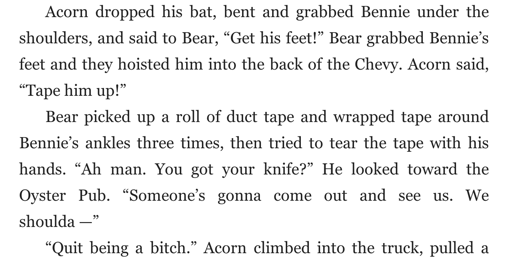
When em dashes appear at the end of a line, we have the same dilemma we had with the ellipsis: the eReader may orphan the em dash, like this:
Awkward looking, no?
But, is this any better?
I inserted a nonbreaking space after "shoulda" to prevent the eReader from making an orphan of the em dash and close quote. If you choose this option, you'll have to do the same for every em dash that appears at the end of a line, to be consistent.
I for one, since I don't edit HTML, will stick with option one and take my chances that the eReader will have mercy on my eBook and orphan few or no ellipses and em dashes.
Thanks for stopping by. While you're here, you could check out my novel The Mighty T for only 99 cents. It's a great introduction to my Grant Starr novels. Available at Amazon or anywhere fine eBooks are sold.
The eBook version of my new novel, The King of Round Valley, was released on Kindle, Smashwords, and Nook today. Smashwords will distribute to the iBooks store and a few other small retailers. The paperback version will be available in about two weeks.
(At the time of this posting, Smashwords is the only retailer where the book is live. I'll update this page and my blog when the other sites go live.)
The King of Round Valley was a fairly easy book to write, but fairly difficult to edit. The entire editing and pre-publishing process too four months—way too long. I blame my wife because, hey, isn't that what wives are for? (Joking, of course.) It just was a difficult book to edit.
As usual, I came to like many of my characters. In past books, some of my favorite characters were bad guys. Take Death of a Matador. I really liked Manny, the murderous, greedy mayor. Perry Dillard, not so much. I liked writing Mindy in The Mighty T and Sunset Hill. Lightfoot was far too cruel to like.
I can't say that I liked Johnny Pipe, the main bad guy in The King of Round Valley, but I sympathized with him having to work with so many dimwitted people. That's gotta wear on you eventually. I enjoyed writing Acorn and Bear because they were so dumb they were fun, but I could never empathize with them. They were too brutal.
Here’s one of my favorite scenes from The King of Round Valley, my most recent and about-to-be-released novel. (I’m currently going through the paperback proof.) It features two of five bad guys in the story, Acorn and Bear. I like it because it demonstrates a couple of things:
One, the life of the criminal can be soooo boring. Acorn and Bear are sitting in front of Hopper Rigo’s house, waiting for Hopper to come out. Sitting around and watching a house is boring, and the time has to be filled with something. How about some idle chatter?
Two, the scene shows that these guys are dimwits. Violent and vicious, but dimwits nonetheless.
The setup: Hopper has been selling meth for Joe Pina at his school in Covelo. Hopper’s in middle school. Joe was selling meth without permission, got beat up by the main bad guy, Sergeant Johnny Pipe, then was told he had until the end of the day to get out of town. Joe wanted his cash and leftover meth from Hopper because all he had was a hundred forty bucks and change. How far would that get him?
Pipe sends Acorn and Bear to Joe’s trailer to make sure Joe leaves town on time. They get there a little early, and because they’re not real bright and didn’t quite understand their instructions, they beat Joe to death with baseball bats and bury him in the foothills surrounding the reservation.
Acorn and Bear set up this meeting with Hopper under the pretense that they’re going to score some meth from him. What they’re really planning on doing is recovering Joe Pina’s cash and leftover meth for their boss, Pipe.
Acorn and Bear sat in Acorn’s pickup, across from the Rigo’s house, down a bit on Lovell.
Bear said, “How long do you think it’ll take Joe’s body to become, you know, all filled with worms and shit?”
Acorn said, “I bet a couple of days.”
“That quick?”
“We didn’t put him in no casket or nothing. We just stuck him in the ground and threw dirt on him. The worms don’t have to chew through anything so they can get to him faster.”
“I thought it would take more like a week, maybe two. The worms gotta find him first, then dig down to where he is.”
“Don’t you know worms are everywhere in the ground? They don’t gotta dig down to Joe, they’re already down there with him. We probably cut some up when we were digging Joe’s grave.”
“I don’t think so. There would be too much, you know, weight on top of them. From all the dirt. It would smash them.”
“Then how could they dig through it if it smashed them?” Acorn turned and looked at Bear. “Huh?”
“Because when you dig through dirt, you make a hole for yourself. So you don’t get smashed.”
“Man, you don’t know what you’re—”
Someone exited the Rigo’s house through the front door, a slender youth with hair down to his shoulders.
Acorn said, “About time.”
In my next post I’ll relate the story I found online that gave me the names Acorn and Bear.
Modern Picture Jones Pumping Plant
Scale: See the vehicles on opposite side of canal?
“There’re two sets of pumps drawing water from the Delta. One’s run by the feds and sends water to Southern California. The state runs the other one, the one blown up last night. It sends water to farms on the west side of the valley.”
Jackson stretched his legs and continued. “The pumps are huge, like 25,000 volts. They suck water out of the Delta and pump it up a hill to a canal, where it flows down the valley by gravity. They put them in back in the 50s and right away knew they had a problem. Fish that got sucked into the pumps were chopped to pieces. So they dug canals to take water to the pumps and put up screens so the fish couldn’t get in the canals.”
“Sounds like it would work,” Grant said. “What’s the problem?”
“Lots of controversy.” Jackson said, wagging a finger in the air. “Fish get caught in the screens and have to be pulled out of the water and trucked back to the Delta, far away from the canals. A lot of the fish die in the truck, plus bigger fish hang around the dump sites and gobble up the smaller ones. This has been going on for more than fifty years and they say it’s drastically affected some fish counts, particularly the little ones. And now that the Delta smelt is on the Endangered Species list, environmentalists are calling for the pumps to be shut off.”
“But if the pumps are shut off, where will L.A. get their water?” Grant asked.
“Exactly. No judge would ever go along with it, which is why they’re going after the farmers’ water first. They figure it’ll be easier to take water from a few farmers than twenty million people.”
* * * * *
Continuing from my last post about certain fish species in the San Joaquin Delta and the Tuolumne River, central to the controversy are two sets of huge siphon pumps. Both draw significant amounts of water from the Delta and ship it south.
What Officer Jackson told Grant in this scene, and what Lightfoot told the gang while sermonizing on the riverbank, is mostly true. I’ll admit I made some stuff up to further the story along (it is a work of fiction) and likely got some other stuff wrong (again: fiction).
But here’s an update to the novel: a federal judge began restricting water deliveries from the pumps in 2007. Restrictions became so severe that much of the west side of Central California has reverted back to desert, unemployment hit 45% in some counties, and billions of ag revenue has been lost.
All because the Delta smelt was put on the Endangered Species List. Here is one of the little buggers, 5 to 7 cm (2.0 to 2.8 in) long:
U.S. Fish and Wildlife Service, Sacramento
Even if this had happened in the novel, it wouldn’t have been enough for John Lightfoot. Yes, the pumps have chopped up over 20 million baby salmon (that part’s true), but the pumps aren’t the whole picture. What he’s really after are the dams that control river flow.
That was the deal he’d struck with the two old Paiutes.
The pumps were for him, for fun. Because he couldn’t stand to let them be.
I enrolled the eBook version my first Grant Starr novel, The Mighty T, in Amazon's Select program a year ago to see it would help boost sales. That means I had to take it off sale at Nook, Apple, and Smashwords (and all the other sellers they distribute to).
Select didn't do much for sales so I pulled the book out and have priced it at 99 cents. I'll leave it there indefinitely as an entry point into the Grant Starr books.
The Mighty T was my second novel, after Canals. Canals is a horror/sci-fi novel that didn't garner much attention from traditional publishers. I blamed that on the genre, which I still believe is somewhat true. I read this in a post by Chuck Wendig titled 25 Things You Should About Writing Horror:
"Horror’s once again a difficult genre. It had a heyday in the 80s and 90s, evidenced by the fact it had its very own shelf at most bookstores. That’s no longer the case at Barnes & Noble, and Borders broke its leg in the woods and was eaten by hungry possums. I’ve heard that some self-published authors have pulled away from marketing their books as horror because they sell better when labeled as other genres."
Sounds reasonable to me, based on my own experience.
So I thought, "Hey, I'll write a thriller! I like thrillers and there are tons of them in the bookstores." And The Mighty T was born.
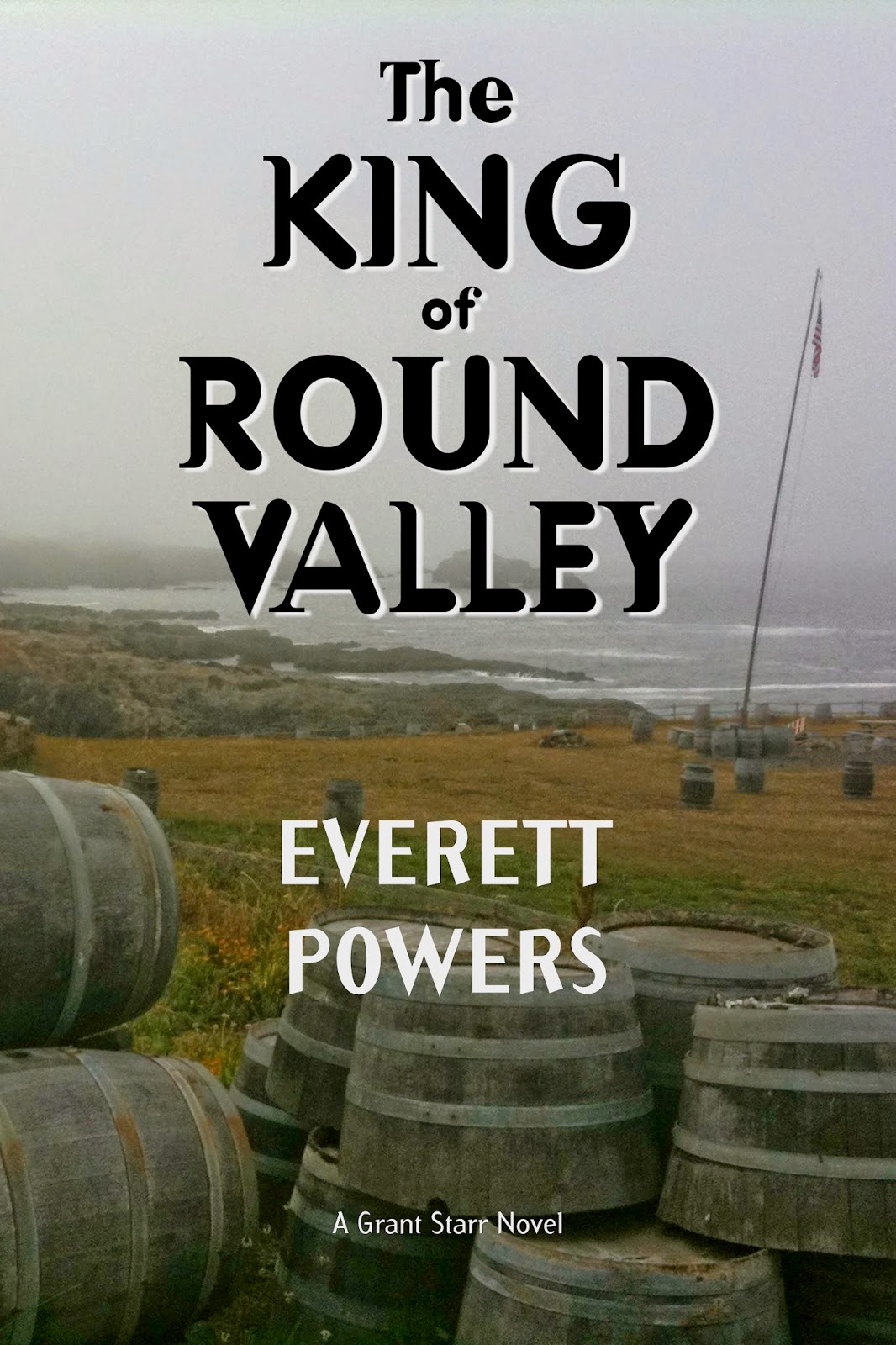
Just six months after posting the eBook cover for my last novel, Sunset Hill, I'm posting the eBook cover for my upcoming novel, The King of Round Valley. Let me show you the cover, then I'll tell you a little about it.
The cover was created using Swift Publisher 3 on my iMac. It's not Photoshop but it suits my purposes, and talent, fine. I applied a light shadow around the title text, but didn't feel it enhanced the rest of the text so I left them plain.
Here's the image before cropping:
Back property of Pacific Star Winery
It was taken on an iPhone 3Gs by Ned Raggett. I found it on his Flickr stream. I ran it through DxO 8.0 to improve the lighting and contrast and to increase it to 300 dpi. Ned graciously permitted me to use the photo for the cover, provided I remembered the second 't' in his last name.
The picture is of the back of the Pacific Star Winery, which I renamed Pacific Point Winery in the book. I like the moody atmosphere of Ned's picture. I felt it suited the novel.
I used two Emigre typefaces for the cover. The King of Round Valley was set in Dead History Bold and the rest of the text in Arbitrary Regular and Bold. I've owned these typefaces since the mid-1990s but feel they're still fresh.
This will be the subject of another post, but I enjoy setting my novels in real places as opposed to imaginary places, and I enjoy using pictures of those places when possible. I used my own pictures on the covers of The Mighty T and Death of a Matador, but I've never been to the Pacific Star Winery so I had to find one. I think readers who live locally enjoy reading books set in familiar settings; I know I do.
I'm waiting to get the paperback proof from Creatspace before I publish the eBook. It seems there is always one or two more tweeks before I feel a book is ready to be released.
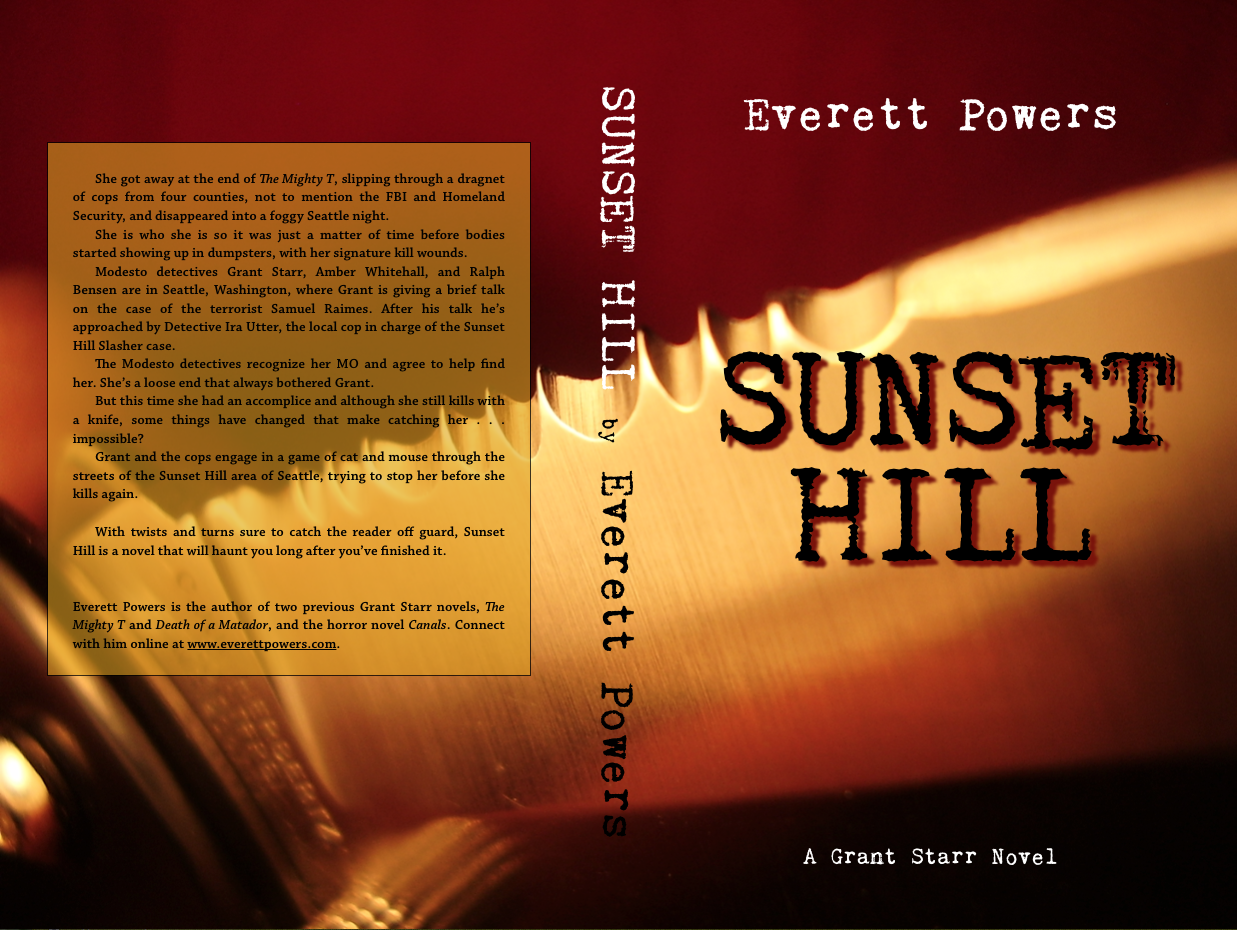
I finished the cover for the eBook version of Sunset Hill today. Here's what it looks like:
It's a little different than the cover for the paperback in that I used more of the ridged top of the knife, to make it look more like a knife.
The typeface is Kingthings Typewriter 2, a shareware face. The creator, Kevin King, allows free use of the typeface. It's one of my favorite old typewriter faces.
The file has been uploaded to Kindle, awaiting my click on the Publish button. I've just ordered my second proof of the paperback and should receive it next week. When the paperback looks good, I'll publish them both.
After uploading the book file, Amazon's spellchecker found two errors. I hadn't capitalized "Adirondack" and I spelled "wimps" as "whimps". I was impressed Amazon caught the.
I'm looking for readers who'd like to receive a free eBook in exchange for an honest review. I can send the book in Kindle, ePub, or PDF formats. Use the Contact Me page or send me an email to ep (at) everettpowers (dot) com
After significant delay, I'm finalizing my new novel, Sunset Hill. In the past I've published my eBooks first, then the paperback. Most of my sales are of eBooks.
However, I found I caught a few more mistakes (aren't there always a few?) when proofing the paperback and had to edit both the eBook and paperback versions; such a hassle. This time I'm publishing the paperback first.
Here's the current version of the cover:
I'll see how the proof looks and make changes if necessary.
P.S. It might appear a little blurry because it was a screen shot. Pages doesn't allow exporting to image formats.
In April, 2011, I attended my first "bloodless" bullfight in Stevinson, CA. I blogged about it here. The bullfight was part of the research for my second Grand Starr novel, Death of a Matador. It was about this time I conceived of another novel with the forcado group as main characters. I'm now in the process of writing that novel, working title The Young Bull Wrestlers.
I'm only about 8,000 words in and have begun writing a scene where the team is practicing at the main character's house in Hilmar, CA. This scene, and a similar scene in Death of a Matador, was inspired by an actual (man I hate that word) experience I had. A patient of mine was well known in the Portuguese (Azorean) community in the Hilmar-Stevinson area and arranged for me to have "back stage" access to the Amadores de Merced team of forcados, or bull wrestlers. I didn't know I'd have this kind of access and so wasn't prepared. I probably could have made more of it than I did.
As I've blogged before, it's important to me that my books be as "real" as possible, meaning I don't want to give a reader an opportunity to say "No way that could happen!" (Canals excepted; it's a horror/sci-fi novel). With this in mind, I've done some research on the basic technique or approach used by a team of forcados.
What Forcados Do
Forcados are called on to wrestle a bull into submission after it's been run around the arena for 15-20 minutes by a matador either on foot or on a horse, so the bull has been worn out to a degree. (Mind you, it still has plenty of energy and fury to run one of its horn through your gut!) At the two bullfights I attended, the horse and foot matadors did not whip up much excitement from the crowd, despite their great skill and artistry. People were talking and eating, trying to stay warm, texting or talking on a cell phone, drinking and laughing with friends, etc. My feeling is they've been to so many bullfights that the novelty is long gone.
But when the horns blow and the chosen eight leap over the wall and strut into the arena, the crowd comes alive. Cell phones drop into laps, children crowd the front of the stands to get a better view, and people quit yapping. (I never saw anyone set a beer down, though.)
The forcado's goal is to wrestle the bull into submission on the first try. From what I've gathered this means their front guy needs to have stayed on the bull's head until the bull has been subdued. If they fail they keep trying until they get it right. It took one team three tries to wrestle the last bull of the evening at one of my two bullfights. (The biggest and meanest bulls are, generally, saved for last.)
Positions
Eight members are chosen to fight each bull. (Some teams have over 20 members.) They are assigned specific positions that have specific tasks. They are as follows:
Position #1: Cara or Caras - "Faces the bull"
This is the guy that leads the team into the arena. His is the position of greatest risk and skill. His one goal is to jump on top of the bull's head, preferably between the horns, wrap his arms around the bull's neck, and hang on until the bull has been subdued.
When you watch my YouTube video I've linked to, you'll notice that #1 is backpedaling when the bull hits him. Obviously, this takes some of the oomph! out of bull's charge.
You should also notice that the #1 position requires some style and grace. He must show the bull that he's not afraid of it by his posturing and verbal taunting (which you can't hear on the video). He doesn't just run into the arena and start yelling at the bull.
#1 is aided by junior matadors who stand outside the wall and distract the bull with their brightly colored capas, or capes. The distraction allows #1 to get closer to the bull. Why? So the bull doesn't hit #1 after charging halfway across the arena. The closer #1 is to the bull, the less inertia the bull will have gained when they collide.
Observe the guy in the #1 position in the following three photos:
#1 is out there in front, by himself.
He jumps on the bull's head. #2 is right behind him.
He is hanging on for dear life.
The last picture is a good segue into...
Position #2: Contra Caras - "First helper"
#2's main job is to see that #1 stays on the bull's head. If #1 is slipping off the front of the head, #2 tries to push him back up. If #1 is about to go over the bull's head onto his back, #2 tries to pull him forward. His roll is one of timing: he's got to get to #1 while the bull's head is down.
This #2 has moved to the opposite side of the bull.
You'll see in this picture that #2 moved to the side of the bull and has grabbed the bull around the neck. His #1 is securely on the top and front of the bull's head. This position can be dangerous because he doesn't get to backpedal like #1 does.
Numbers 3, 4, and 5 have entered the frame. 2 and 3 are there to...
I admit I don’t visit Goodreads often enough. Sometimes not for months. But, when I do, I like to see if any new reviews have been posted for my novels. I found one today. Here’s the link in case you want to see the original review. Here’s the text of the review:
Canals starts off as a typical crime thriller as Detective Daniel Lawless comes to the scene of a dismembered body by a canal in California. Everett Powers then develops a wonderful story written in the style of a good police drama. Every character the reader meets is given a full introduction, it is not a case of "this is John, a 20 year old man" - you get to know each character as a real person. This character development is true for everyone, whether they continue to the end of this novel or meet a violent death.
Detective Daniel Lawless is a different type of policeman and has a quirky character. He likes opera and has a collection of 82 pairs of shoes giving him the nickname of shoe boy when he was at school. Before he can solve this death by the canal, another death occurs along a nearby canal. Something is going on around the canal network but can Danny solve the case before more people are killed?
Slowly the reader finds that this is not your typical crime thriller. Little bits of information are drip fed into the story to make you think that something nasty may be lurking in the canals. Bit by bit this story becomes a science fiction novel.
Everett Powers develops a wonderful plot that bit by bit becomes a race for Daniel Lawless to save the day. The reader along with Daniel begins to understand just what is going on along the canals and we begin to get the bigger picture.
Canals is a very entertaining read. I like the way it moved from a crime thriller to a thought provoking science fiction story. The message at the end is very moving and forces you to consider real life global issues.
I can find nothing wrong with Canals. It is a great story that was told with precision and detail. The writing is top quality and it was a joy to read. I enjoy walking my dog along canals and now I will always wonder what may be in the water. I vote this book the top score of 5 stars. Canals is available as a 609 KB Amazon Kindle eBook and was written in 2011.
CANALS was the first novel I completed and my only horror/sci-fi novel. The Grant Starr novels are thrillers. CANALS can be purchased for 99 cents right now at your favorite ebook retailer. I noticed Amazon is selling the quality paperback for $14.39, though I don’t know why. I never lowered the price from $15.99 and it’s sold only on Amazon.
I finished the first draft of my adaptation of The Mighty T to the silver screen. It weighs in at 120 pages, about 20 above my goal.
I was advised that new screenwriters shouldn't turn in scripts longer than 90-105 pages, but when I looked at the winning scripts for the recent Nicholl competition, they were all about 120 pages. We'll see how it looks after edits.
Some nuts-and-bolts stuff about my process.
1. The screenplay resides in Scrivener for Mac at the moment and will until it's ready for submission. Scrivener has a screenwriting mode, which makes it easy to format while you write.
2. I have Scrivener sync the screenplay onto Dropbox in Fountain format. That way I can work on it on either my iPad or, as I did yesterday, on a PC. Edited documents synced perfectly the next time I load Scrivener. I tried typing a new document using Fountain syntax but Scrivener put it in a trash folder when it synced. I'm not sure why. I copy and pasted the new doc into Scrivener but had to format it line by line. Kind of a hassle.
3. I wrote with iA Writer on the iPad and Word on the PC. I've used a Mac since March and it was a bit rough going back to a PC. It didn't help that it had a cheap keyboard with poor tactile feedback.
While waiting for feedback from some excellent readers who are reading SUNSET HILL, I decided to try my hand at adapting one of my novels to film; i.e., write a screenplay. I thought, I've written four novels, how hard could it be to write a screenplay for one?
Little did I know...
Screenplays and novels are not alike in the least. Novels can be 350 pages of prose while a screenplay should come in at about 100 pages. And no prose. They must consist of mostly action and dialogue with very little description. If a character must be described, it should be no longer than one sentence.
Peter Stone was the screenwriter for the original The Taking of Pelham 1-2-3 (1976) (Stone passed away on 2003.) He's an Oscar, Tony, and Emmy winning writer. He talked about the differences between writing a screenplay and a novel in the commentary feature on the Charade DVD.
“When I couldn’t sell the original screenplay (for Charade) I was advised by my wife, and my agent concurred, to turn it into a novel. I had never written a novel and it was in the course of writing the novel that I came to realized that I had no ability for writing novels at all. It’s a different set of muscles. There are very, very few people who can write dramatic material and narrative prose. Very few. Chekhov could do it. There are some today who can do it. Richard Price can do it. Crichton. They just call on a different set of muscles. One is descriptive and uses language in a way that dramatic material does not.
Dramatic material—everything has to be revealed through behavior, that’s all you have to reveal it with. And description plays such a small part in it. It’s just a different set of muscles at work and I don’t have them, or I never developed them, or I wasn’t interested in them or something. But I sure discovered it immediately. So it was a rotten novel.” (Emphasis added.)
"A different set of muscles." That's exactly what it feels like to me.
I've decided to adapt The Mighty T for film.
I Googled screenwriting, found a bunch of good information, and talked to a writer I met on Twitter, Katherine Bennet, who is a screenwriter. Alright. Ready to write that screenplay. After I reread the book. It'd been a while.
When I stopped to come up for air, I was 45 pages in. Unfortunately, I was on page 37 of the novel. Yeah, that won't cut it. At that pace I'd end up with a 500 page screenplay, enough for five movies.
Back to the drawing board.
Katherine strongly suggested using Chris Soth's Mini Movie Method: Organize the screenplay into eight "mini movies," each 12-15 pages long. It is supposedly the format Hollywood is looking for in a screenplay. I just couldn't wrap my brain around that format, though. Not for The Mighty T, at least. And, I'm very impressed by the movies coming out of Hollywood these days. Most are terrible.
So, instead, I decided to use the three acts format, with act 2 broken into two parts. I've organized the novel thusly:
Act I - the killing of the utility GMs
Act II, Part 1 - blowing up the Jones Pumping Plant
Act II, Part 2 - blowing up the O'Shaughnessy Dam
Act III - the attack on the Don Pedro Dam
Each act gets about 25 pages.
The task then becomes, what to cut from the novel? Obviously, much has to be cut. In fact, most of the novel has to be cut. And that hasn't been easy. I've had to cut scenes I really like. It's been a little like having a family of 50 but only being able to take 10 with you on vacation.
I'm currently into Act II, Part 2, with 54 pages written. (According to Scrivener's page count.) I'm writing the draft for screenplay in Scrivener, because I love it and already own it, but will have to get a dedicated piece of software for the finished product.
My next Grant Starr thriller, SUNSET HILL, is with the beta readers. Here is an excerpt from Chapter 8.
Grant and Detective Ira Utter of the Seattle Police Department are in Utter’s car heading for a woman’s prison in Gig Harbor where they will interview a convicted killer. Grant is going to try and get the killer to give them the name of her accomplice, who’s started killing again.
Utter is a new character, naturally because he’s in Seattle, Washington, and the other two Grant Starr novels were set in Central California. I didn’t like him much at first because he’s so straight-laced and kind of boring. And, frankly, I didn’t like typing out his name much. But he grew on me and I came to appreciate him, and understand him. His character is in large part his attempt to separate himself from what he was: a drunk.
Grant’s sure the killer they’re looking for is Mindy, who escaped an intense police dragnet after the failed attempt to blow up the Don Pedro Dam in La Grange.
Utter and Grant got into Utter’s department-issued Chevy Impala, and Grant asked Utter, “An Impala, huh? How’d Seattle PD end up with Impalas? I don’t think I’ve ever seen a cop driving one.”
“It’s a long story. The short of it is, Chief Dunston’s brother owns a Chevy dealership. They’re not bad cars.”
“I heard they suck.”
“Well ... okay. They do suck. Fortunately, there’s little call for a Seattle detective to engage a suspect in a high-speed chase. We have highway patrol Dodge Chargers for that.”
Grant laughed. “You call in the HP for all car chases?”
“Not all, just the ones where you suspect you might need to go more than eighty. The Impala starts to shimmy at eighty.”
Grant laughed again and said, “How’d the media thing go?”
“Okay. I remembered not to frown.”
“Kept a poker face?”
“Well, it wasn’t like I was being grilled by Mike Wallace or anything. Keely Wolfe asked about you and the others, who you were and why you were here. I said you were consulting because there might a tie-in with a cold case of yours. I hope you don’t mind.”
“I don’t see any harm in it. If you didn’t tell them who we were, they’d think we were feds. That I would’ve been pissed about.”
They swapped stories for thirty minutes until Utter said, “I Googled you this morning. 1970 Ferrari Daytona, huh? From trading stocks?”
“Nah. Short-selling stocks. But I’m out of the game now.”
“Sounds like it was lucrative. And a lot safer than hunting killers. Why not retire and do the stock thing?”
“Because I’d go nuts. Short-selling gave me something to do at night while I dried up. I’d wake up at two or three and flip the computer on, run the numbers instead of reaching for a beer.”
“How long did you drink?”
“Started in high school and didn’t quit until I was twenty-six. Too long, but I know guys who still drink like they did in college, and they’re fifty now.”
“Why’d you quit? If you don’t mind me asking.”
“I don’t mind. I had a woman walk out on me. I thought she was the one, but ... turns out she didn’t like angry drunks. Who can blame her? Hell, I don’t like angry drunks.”
“You in AA?”
“Nope.” Grant turned to look at Utter. “Her leaving was enough of a shock that I just quit. Didn’t feel like I needed any help. You sound like you have a story. You in AA?”
Utter nodded and said, “I’m an alcoholic. A recovering alcoholic, as they teach us to say. Unlike you, I can’t touch a drop. Just smelling a beer makes me break out in a sweat.”
“How long you been sober?”
“Five years, sixty-two days.”
“Still go to meetings?”
“Oh yeah. Probably will the rest of my life, or until I’m too old to drive myself there.”
“I guess your marriage survived. Or is this wife number two?”
“No, Lacey hung in there. Probably for the kids’ sake. I think she’ll leave after they move out.”
“Why do you say that? The worst is over, man.”
“The damage has been done, you know? Say you tell someone you hate them and suggest they jump off the Space Needle. You can apologize the next day, but you can’t take the words back. They’ll always be there, floating somewhere in time and space. Some things can’t be undone.”
“Ah, time can heal most wounds, Ira. She’s stuck with you this long, she’s probably gonna hang in for the long haul.”
Utter was quiet for a few moments, then he said, “I think she’s having an affair. In fact, I’m almost positive she is.”
“Ah man, sorry to hear that. You think it’s a revenge thing? Getting back at you for the years of drinking?”
“Could be. I’m thinking about confronting her about it. What do you think?”
Grant blew out a breath, and thought through his answer. “I hate to think I’ll ever have to deal with that, but if I do, I’ll confront her for sure. There are few things worse than someone you love sneaking around behind your back.”
They were quiet for a while, then Utter said, “Did I tell you she wears makeup to Zumba? Who wears makeup to Zumba?”
“Women care about their appearance more than men, even at the gym. In fact, when I used to go to a public gym, most of the women there had makeup on.”
“Zumba lasts an hour, but she’s usually gone two hours. Sometimes three.”
“Ah man...”
“Yeah.”
The Washington Corrections Center for Women was tucked into a corner of McCormick Forest Park, off Washington State Route 16. Utter exited at the Burnham Interchange, wound down Sehmel Drive, then hooked a left on Bujacich Drive, which cut through the park as it led to the prison.
“Sure is pretty country,” Grant said. “Is it always this green?”
“It’s why we’re called the Evergreen State,” Utter said. “This side of the Cascades is always like this. It turns white when it snows, but otherwise is green year round. I assume you’ve got a plan for interviewing Sorrentino? Is there anything you want me to do? Keep my trap shut? Play good-cop bad-cop with you?” He smiled.
“I’ve got a plan, but nothing elaborate. Feel free to jump in if you think you have something to add.”
When they pulled into the prison parking lot, Utter said, “Is there anything you want to ask me about Sorrentino before we go in?”
“I think I got all I need from the files.”
I've been busy lately with my paper edit. I blogged about this before here.
I edit three different ways:
1) On-screen
2) On paper
3) On an eReader, in my case an iPad
I finished the on-screen editing a couple of weeks ago and am in the 12th chapter of my paper edit. Sunset Hill will have 14 chapters, so I'm almost done. I'll probably do a second paper edit on chapters 12–14. They're the most recently written chapters and so haven't been gone through as much as the others, and they're the most important because... You'll have to wait and see.
I'm pleased I'm finding very few actual typos or incorrect word usages. The most common error to pop up, 3 or 4 times, has been "there're" instead of "they're". And I've changed a lot of "in"s into "into"s.
I write and print manuscripts in Courier, size 11. 12 is too big and 10 is too small. 11 allows for just the right about of text on a line. The paragraphs are 1½-spaced, not double-spaced. I don't need them to be double-spaced.
I'm using a Nakami Vanishing Point fountain pen for editing, with a fine nib. The nib size is just right, allowing me to write more than you'd think between the lines and in the margins. I don't use the plastic cartridges but rather fill it from an ink bottle. The pen is very easy to fill. I use the Delta brand ink, at Bert's recommendation.
The pen looks just like this:
The nib appears when you push the button at the other end of the pen. Otherwise it's safely nestled inside the body of the pen where it won't cause a mess. The pen finds nicely in a shirt pocket and is rather large; perfect for my big hands.
You can buy the pen at Bert's Inkwell, if you like. Don't forget to get a bottle of the Delta Ink. I use blue ink because it's easily seen on a black and white page and is appropriate for all other writing uses. Other colors such as red would be more visible on the page, but you shouldn't write on checks or sign important documents with colors like red. Blue is universal.
I've also used a Pilot Precise V rolling ball pen for editing. (Pilot makes the Nakami Vanishing Point pen as well.) It has a very fine writing point and displays how much ink is left so you know when you're about to run out. But, a fountain pen has so much more class than an ordinary rolling ball pen, and I like to use my expensive purchases when I can.
As for printing the drafts, Scrivener makes it easy. Chapters are set up as folders in Scrivener's Binder display. Each scene is a text file in a chapter folder. In scrivenings mode, where the scenes of a chapter appear as a continuous stream of text, I click File, Print Current Document. On my Mac, the print screen tells me how many pages are in the chapter so I can be sure I have enough paper in my old LaserJet 1320. I buy Georgia Pacific multipurpose paper from Walmart for about $3.50 or so a ream, the 92 brightness paper.
I finished the first draft of SUNSET HILL a couple of Saturdays ago. I had originally set a goal of 100,000 words, but it came in long at 119K. I'm okay with that; CANALS was 150K, THE MIGHTY T 105K, and DEATH OF A MATADOR about 125K. As I wrote here, 125K is a good length. For comparison, King's UNDER THE DOME has about 335K words.
The word count will likely grow by the time I finish with edits. I feel like it needs a short chapter to wrap-up loose ends, but I have mixed feelings about that. I tend to overdo wrap-up chapters.
Wrap-Up Chapters
CANALS had a fairly long epitaph where I wrote a follow-up on the church the monsters had done their worst work in, and a long follow-up on Lawless and Baskill. I thought the Baskill thing worked, but some readers said it should've been left out.
In THE MIGHTY T, I wrote a lengthy follow-up on the restoration of the Hetch Hetchy Valley, or what I guessed might happen should the O'Shaughnessy Dam be removed. I received a little criticism for that, too. That novel has quite an exciting ending and some readers thought I should've left well enough alone.
DEATH OF A MATADOR originally ended with the capture of ______ (no spoilers—you'll have to read it to learn who was captured and who got away). One beta reader complained the ending was too abrupt so I wrote a few pages of wrap-up. It was brief.
I think most readers want to know what happens to at least the main characters, but in particular they want to be reassured the bad guys didn't get away with it. Even though in real life they often do.
Editing The First Draft
Most editing done on the first draft is mundane work. I like to use real street names, real business names, real landmarks, etc. Often, when I'm working on a first draft, I don't want to stop writing to look back in the text for the correct street or business name because it can break my rhythm. I'll put an *asterisk by whatever I choose to write, which lets me know it needs to be looked up when I'm editing. Or I'll put something in parentheses.
I rarely make big story changes when editing the first draft. I try and make sure I've thought through logistical issues when penning a first draft so I'm not bothered with them later.
For instance, in SUNSET HILL I've got a bad guy with a cop's iPhone. iPhones have GPS functions and are fairly easy to track, if the phone is left on. Cops would know this yet I had the cops not thinking of it. Cops wouldn't normally bother with tracking a phone that's been stolen, but they would if the thief is a cop killer. I had to rewrite several scenes where I had the bad guy actually get rid of the phone.
If I don't catch stuff like this while writing the first draft, I'll catch it during the first edit.
The first edit is done electronically, meaning I either edit on-screen or on my iPad. I have Scrivener sync the manuscript with Dropbox and use Storyist for the iPad to edit the .rtf files in the draft. Storyist doesn't save the file to the same directory in Dropbox, which gives me a layer of security.
Yesterday I topped 100K words in the novel I'm writing. It got me thinking about novel length. These days, the general consensus seems to be most readers enjoy novels in about the 80K area, give or take 10K words. I gleaned this from reading various blog posts and opinion pieces on the great big Internet.
I like a novel that's a bit longer than that, 100-125K, or 325-400 printed pages, but that preference has evolved. Back in the day, I used to like long novels like those written by Stephen King and Tom Clancy. How many novels have those authors published that pushed or topped 1,000 pages? King, several. Clancy, maybe in the 700-900 page range.
CANALS came in at 200K words at first and was trimmed down to about 150K, or about 425 pages (I think). THE MIGHTY T weighs in at a little over 100K and about 325 pages. DEATH OF A MATADOR was in between: about 125K words and in the upper 300s pages. (If I was writing this at home I could look on the shelf at the page counts, but I'm not. I'm in my office-away-from-home: the local Starbucks.)
I'm currently reading UNDER THE DOME by King, and I'm generally loving it. But I think it's too long. I have the ePub version I'm reading on Marvin for iPad, and Marvin tells me DOME had 336K words. If King was a young author trying to get a publisher interested in his manuscript, and he sent in a 336K manuscript, it would've been sent directly to the recycle pile. No passing GO, no collecting $200. By contrast, SILKEN PREY by John Sandford, which I recently read, weighs in at 109K, according to Marvin. DOME is three time longer than SILKEN PREY, and it feels it.
DOME is a great story with delicious characters. I'm 70% into the book now and find I'm reading faster, because I want to see how things turn out. I want the main bad guy to get what's coming to him, and I want him to suffer. I'm anxious to see how the "good guys" take the Dome down (see, I'm capitalizing Dome, too). I understand the main good guy, or supporting good guys, might die in coming pages, and I'm okay with that. But I'll be disappointed if Rennie doesn't get it in the end. King wrote him very well: a delectable bad guy.
I recently received a 5-star review for my horror novel, CANALS. It now has an average of 4.6 stars over 10 reviews. The review is brief so I've copied and pasted it in its entirety.
"This book kept me on the edge of my seat and made my heart race! I grew up in Modesto and it was interesting reading about places I am actually familiar with. I highly recommend this to anyone looking to really get involved in a great thriller! I got this book for a low price of .99 cents, but had I pay $10 it would definitely have been worth it and I would not have been disappointed! Awesome!"
Now, I admit it might look like I know this person. Let me assure you I don't. She purchased the eBook for 99 cents, read it, and left a review of her own accord.
I had hoped, when writing CANALS, that it would appeal to Modesto-area residents. The locals who've read the book have said they enjoyed reading about local sites and businesses, but it hasn't yet caught on big. I'd imagined throngs of citizens gobbling it up... A goal for the future.
I was fortunate enough to be interviewed by author Eden Baylee. I've done several of these interviews and while I've enjoyed them all, I really enjoyed this one because Eden asked some of the toughest questions.
I recently finished reading a book titled "The Rose Hotel" by Rahimeh Andalibian. It's worthy of a review and post.
The story begins in Iran shortly before the Islamic Revolution in the late-1970s and follows a family who owned a hotel called, you guessed it, The Rose Hotel, into the present time. Much has been written about Islam by both friends and foes since 9/11 and I thought this book might give me some insight into the life of an Islamic family unaffiliated with terrorism, or with what I think of as "militant" Islamic beliefs. It did and I'm glad I read it.
The family is thrown into turmoil when the oldest boy is arrested after the revolution and is sentenced to death for crimes he didn't commit. He's only sixteen. The grief and remorse his death causes traumatizes the family for a generation.
The book details the family's journeys to England and the United States, how the parents face the challenge of their children becoming westernized, how the children deal with what happened to their older brother, and how they eventually realize they must face what happened together if they wanted to survive as a family.
At first I was a little annoyed that everything in this family's life revolved around the oldest boy, I mean everything. The mother nearly killed herself with grief and I am, frankly, surprised the parent's marriage survived considering the depth of her grief and the depth of the father's guilt. I would like to think that, God forbid, if something so tragic happened to my family we would find a way to move on quicker than the family in this book moved on. It nearly destroyed the parents marriage, drove one brother to drugs and another to reckless financial behavior, and caused many years of grief and, likely, illness, as chronic stress usually leads to illness.
But, I've never walked in their shoes and have no idea what it would be like to lose a child or loved one like that. He was taken from them unjustly and condemned by people who should have been honest and upheld the law.
If this sounds like your cup of tea, the eBook can be found on Amazon HERE, as can the paperback, which, oddly, if you don't mind a used copy, can cost less than the eBook.